

notes from the ground (part 1: writing)
exploring the garden through words

This post is a part of a series where I am exploring my immediate natural surroundings — the garden around our house in Puglia, South Italy — through a different medium each time. Each long walk around the garden finds its expression in writing, photography, film, sound, or another medium. I only use natural intelligence in the process of making this — my own and that of the nature around me.
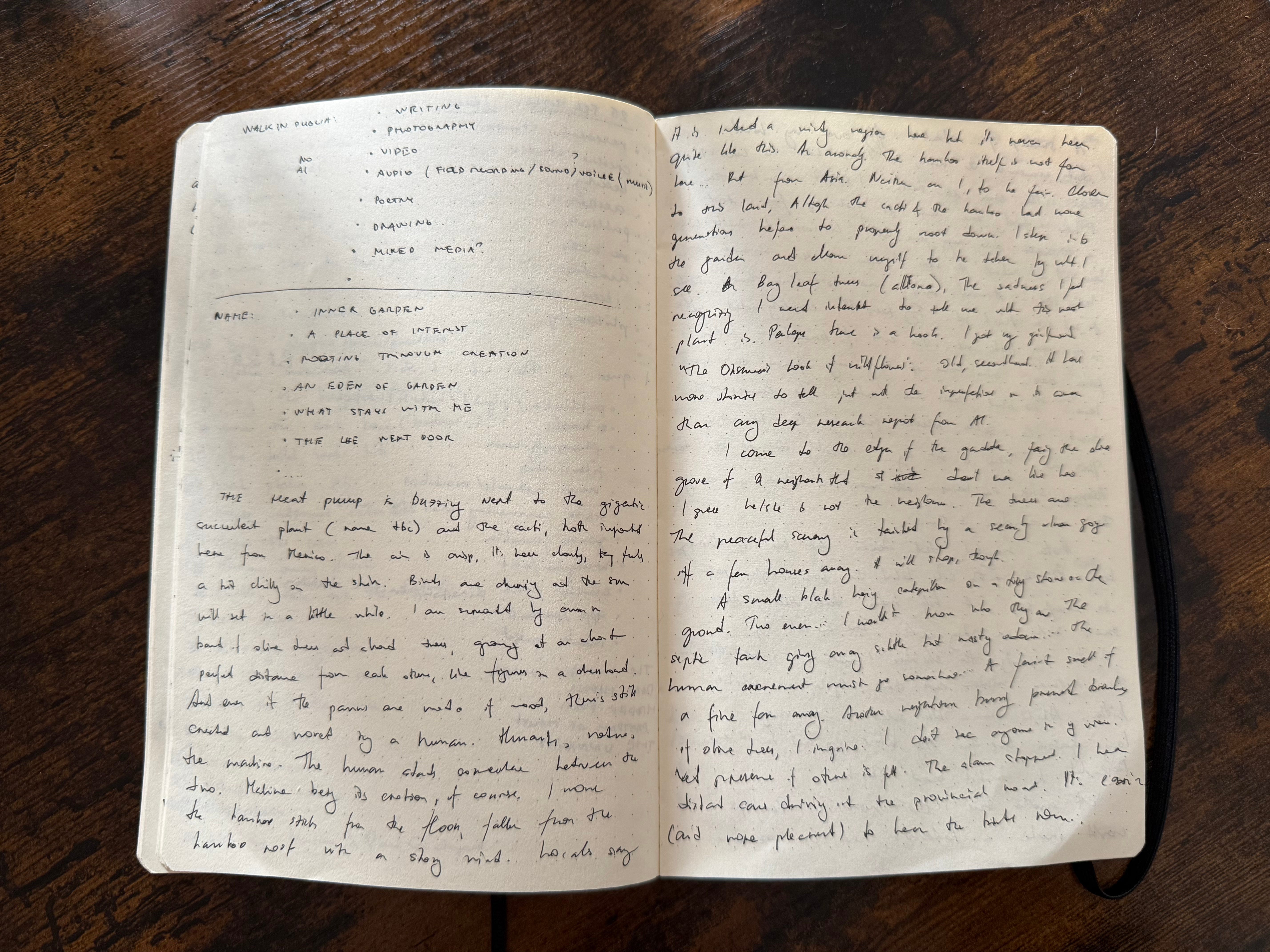
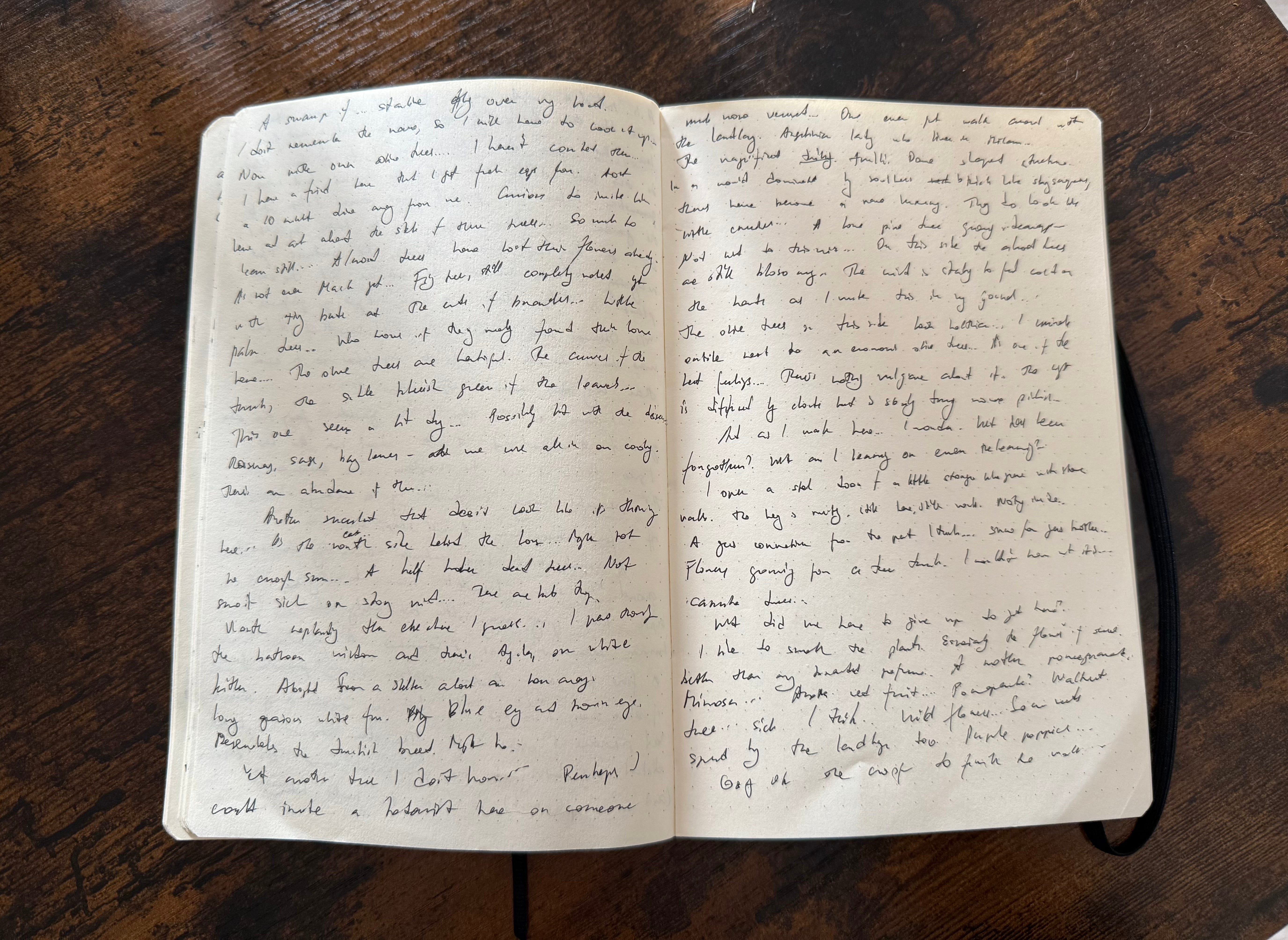
This is the first post, where I used a journal to write down my observations and thoughts during my walk, later typed out and expanded on the computer. To see other posts in the series, you can go here.
28 Feb 2026, 4:21 p.m.
Puglia, South Italy
The heat pump is buzzing next to the gigantic succulent plant, an agave americana and the prickly cactus (called fico d’India here in Italy), both imported here from Mexico. It’s common across the Mediterranean, and of course, we also saw plenty of them in Mexico.
The air is crisp and feels a bit chilly on the skin. It’s been somewhat cloudy today. Birds are chirping, and the sun will set in a little while.
I am surrounded by a band of olive and almond trees, growing at an almost perfect distance from each other, like figurines on a chessboard. And even if the pawns are made of wood, they are still created and moved by a human.
Humans, nature, the machine. The human stands somewhere between the two. Machine being a creation of the human, of course.
I move the bamboo sticks from the floor, fallen from the bamboo roof possibly due to a strong wind a few days ago. Locals say it is indeed a windy region here but it’s never been quite like this. An anomaly, they say. The bamboo isn’t from here either, or Europe even. Neither am I, to be fair. Closer to this land, although the bamboo, the cacti and the agave had more generations before me to properly root down here.
I step into the garden and allow myself to be taken by what I see. Bay/laurel tree, one of the plants native to this land that is often mentioned in the classical Greco-Roman culture (worn as headpiece for instance).
The sadness I feel when recognizing I need internet to tell me what this next plant is. A “mock orange” or Japanese cheesewood as I learn upon checking. A plant originally from East Asia.
Perhaps there is a book for this. A botanist’s guide or something. I gifted my girlfriend a little old book called “The Observer’s Book of Wild Flowers”. It’s second hand, older than me and has more stories to tell just with the imperfections on its cover than any deep research report from artificial intelligence.
I come to the other edge of the garden, facing the olive grove of a neighbour that doesn’t live there. I guess he/she is not the neighbour. The trees are. It’s just a small agricultural plot of land. A screeching security alarm is tainting the peaceful scenery a few plots away. It will stop, though.
A small black hairy caterpillar is slowly sliding across a tiny stone on the ground. Two even… I wouldn’t know what they are.
A faint smell of fire far away. Another neighbour burning pruned branches of olive trees, I imagine. I don’t see see anyone in my view. Yet presence of others is felt. The alarm stopped. I hear distant cars driving on the provincial road. It’s easier (and more pleasant) now to just hear the birds.
A swarm of starlings is just flying over my head. I learned about them recently as I saw them making hypnotic shapes in the sky, flying in flocks with perfect synchronicity.
I’m now with our olive trees. I haven’t counted them. There’s a friend here I buy fresh eggs from who does biodynamic farming and takes good care of olive trees on his land. Feeling curious to invite him here and ask about the state of these trees. So much to learn still.
Almond trees have lost their flowers already. It’s not even March yet and they went through full bloom cycle. The fig tree is here, still completely naked yet with tiny buds at the ends of its branches. Little palm trees, yucca I think they call them. Who knows if they really feel at home here.
The olive trees are magnificent — the curves of the trunk, the subtle blueish green of the leaves. But with intensive olive tree monoculture around they feel… overpopulated? Still special, if I take the time to look at one.
Rosemary, sage, bay leaves — we use all these herbs in our cooking. There’s an abundance of them.
Another succulent that doesn’t look like it’s thriving here. Possibly because it’s the north-east side of the house and it might not get enough sun.
Yet another tree I don’t know. Perhaps I could invite a botanist here or someone much more versed than me. Or even just walk around the garden with our landlady.
I’m now facing the magical trulli. It’s a dome shaped little structure that is part of the house — they used to be agricultural structures in the past that were easy to dissemble and assemble (in fact to avoid paying taxes to the Spanish empire rulers). In today’s world dominated by soulless brick like glass skyscrapers, these have become somewhat of a rare luxury. They do look like little churches.
A lone pine tree growing sideways. Not used to this wind. The wind is starting to feel colder on the hands as I write this in my journal. I pass water next to an enormous olive tree. It’s one of the best feelings. There’s nothing vulgar about it.
The light is still diffused by clouds but is slowly turning more pinkish.
And as I walk here, I wonder. What has been forgotten? What am I learning or even relearning?
I open a steel door of a little storage space with stone walls. The key is rusty. Still here, still working. Nothing inside. A gas connection from the past I think…. Space for gas bottles.
Flowers growing from a trunk nearby. It’s probably a cherry tree but not in its most thriving shape.
What did we have to give up to get here? I think I’m only starting to scratch the surface of these questions.
I enjoy smelling plants, especially the flowers of course. Better than any branded perfume full of who knows what.
A pomegranate tree. A mimosa. Walnut tree, probably sick. Wild flowers. Some of them were seeds spread by the landlady. Blue poppies as I learned are called blue anemone flowers. The word anemone comes from the Greek anemos meaning “wind,” referring to how easily the petals are blown off by the breeze.
Going on the roof of the house now to finish the walk and enjoy the view from above.
As I find myself back inside the trullo now typing this out, I’m present some of the questions and curiosities from earlier.
What did we have to give up and pay to get what we “have” now? What has been the price of modern way of life?
Being removed from villages, where everyone knew each other, lived by the seasons, ate the food they produced — to instead be put into a box in a huge apartment complex, surrounded by wifi radiation, polluted air, food delivered in plastic on scooters just a click away, groceries being available from all over the world sprayed with intense pesticides and stored in the huge air conditioned cement block called a supermarket.
Of course I romanticise. But do I? Of course there was hardship in the older more natural way of life, especially without some of the technology available today. But, was it really that bad? And the life we take as “normal” now, how good is it actually? Somewhere along the way, we’ve lost our way. Not us specifically but us as humanity. Not everyone. But most people, at least in the West.
We gave up the more natural ways of living for what exactly? Improving quality of life? That would be the narrative for the buy in. But it doesn’t add up — the quality of life hardly improved in the greater sense. If anything it got worse, at least in some areas.
No. It is to feed the machine. But more on that another time.
Perhaps my future writing will explore this in more depth. All I am interested in finding the truth and seeing — and feeling — reality as clearly as I can.
For now, I will continue rooting here.
Exploring the garden through the mediums available to me while grounding myself.
Can’t wait to see the video / photo ones 🥹 love this!
your garden sounds so vibrant and warm. i noticed that you described the things you knew in more detail than the plants you were unfamiliar with. i wonder, what would it be like to describe it as someone who’s the first to discover it? i feel connected to the cycle of forgetting and remembering when i embody the first one to notice without having known descriptors. just a fun practice of presence i do that this beautiful piece reminded me of. thanks for sharing!